
Scottish democracy in action shows how cynicism of populists can be defeated – Dr Bernhard Blumenau
A polycrisis of trust is threatening to wreck vital institutions at home and abroad but decisions over fracking and hyperscale data centres show mainstream politics can respond to public concerns effectively

In August, a drone with explosives was found beside a Ukrainian cargo aircraft at Leipzig airport. Berlin blamed Moscow. The target was never just the aircraft. It was our confidence that the state can keep us safe.
We’ve grown used to talk of a polycrisis: several emergencies at once. What we face now cuts deeper, into the way we organise society. It is a polycrisis of trust. Confidence in governments, institutions, experts and allies is eroding all at once.
The proportion of Britons who trust governments to put the national interest ahead of party interest has fallen from 40 per cent in 1986 to just 12 per cent, the lowest ever recorded. Trust in the Scottish Government to work in Scotland's best interests has fallen from 81 per cent in 1999 to 46 per cent last year.
What produces this is not a conspiracy, but a cacophony of many actors whose motives differ. The effect is the same, and it’s serious.
The Trump effect
The purpose of ‘hybrid warfare’ attacks on Europe's infrastructure is intimidation: to persuade citizens the state can’t protect them and that abandoning policies like support for Ukraine is the price of safety.
An ally has also caused real damage. For decades, we could be confident that Nato allies would defend one another, borders would not be redrawn by force, and trade would follow international rules.
All this has now been called into question. Donald Trump has made America's commitment to collective defence sound conditional, laid claim to Greenland, the territory of Nato member Denmark, and turned tariffs into instruments of coercion against partners.
Old truths no longer hold, nor does the trust built on them. All of this plays into Moscow's hands.
US backing Europe’s nationalist parties
Danish authorities recently warned of a “low but growing” risk that Russia could launch a limited attack on a neighbouring Nato member. The gamble is that Nato will not respond as one. Every doubt sown in Washington is a wager Moscow can place.
The US is also casting doubt on Europe's institutions. The US National Security Strategy claims Europe faces “civilisational erasure” and pledges support for nationalist parties. Russian actors pursue the same end by cruder means: interference, fake news, manipulation.
Domestic actors do the rest, eroding trust from within. Populists cast doubt on the good faith of parliaments, courts, agencies and experts, offering simple answers to complex questions. Not because they misunderstand the complexity, but because painless solutions sell better.
It works. The AfD won 43.8 per cent in Saxony-Anhalt in September. In May, Reform finished joint second at Holyrood with 17 seats.
Cynicism vs scepticism
Not every grievance such parties exploit is invented. Public services are stretched, living costs are high, and too many promises have gone unkept. Things do need fixing.
But the answer is to repair the system, not break it: to throw out failing policies, not distrust the institutions that allow us to change them.
What populists sell is cynicism dressed as scepticism. The latter is the lifeblood of democracy: testing claims against evidence, holding politicians to account, and changing your mind when the facts change.
Cynicism assumes bad faith whatever the evidence shows. The sceptic asks for proof before being convinced otherwise. The cynic has stopped asking.
AI undermining reality
The danger is what follows. As trust drains away, it becomes easier for those hostile to institutions to remake them in their own image. Trump has sacked officials who displeased him. Remove the checks on power, and the system starts to crumble.
Technology amplifies the problem. As AI improves, nobody can be sure what a politician really said or did. The greatest danger may be that genuine evidence is dismissed as fake.
Then there’s the retreat from expertise, as seen during the Brexit campaign, when Michael Gove declared people had “had enough of experts”. Trump’s health secretary has swept aside evidence-based advice on vaccines.
As trust in academics drains away, little remains but opinion and belief. When those guide our actions, we begin to undo the Enlightenment.
A sense of doom, a source of hope
History does not repeat, but it rhymes. In Germany, the Weimar Republic saw political instability, mass unemployment, street violence and a sense of doom. The Nazis prospered from crises they helped create. In 1933, conservatives who believed they could contain Hitler brought him into government. We know how that ended.
The context today is different, but the warning stands: democracies are rarely killed from outside, they are hollowed out from within.
So how to avoid this fate? Scotland shows how change can be achieved through institutions. When fracking was proposed, communities organised and took part in a consultation informed by economic, environmental and health research. Holyrood concluded there was little public backing and adopted a policy of no government support.
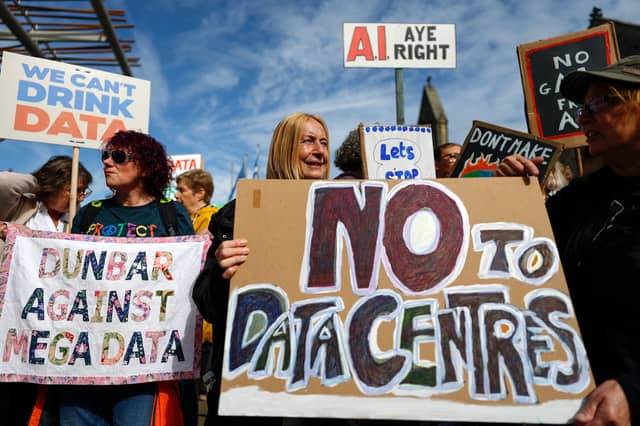
Hyperscale data centres were being pushed through planning without automatically requiring a full environmental impact assessment. In Larbert, more than 7,000 people formally objected, and campaigners elsewhere pressed the case. The Scottish Government recently made the assessments mandatory for larger data centres.
That’s not a verdict on data centres. It shows that democratic scepticism can still shape policy.
Institutions worth defending
The answer to a polycrisis of trust is neither blind faith nor blanket cynicism. It’s a presumption of good faith towards our tried-and-tested democratic institutions, combined with relentless, constructive scrutiny of politicians.
The same holds for allies. The response to an unreliable partner is to build trust with reliable ones – like the UK moving closer to its neighbours – not to conclude that cooperation is naive.
The drone at Leipzig was meant to teach us that our institutions cannot protect us. Larbert suggests otherwise.
Let us be sceptics, then, and trust that our institutions are worth defending against hostile forces, outside and within.
Dr Bernhard Blumenau is a senior lecturer in international history and politics at the University of St Andrews
Comments
Want to join the conversation? Please or to comment on this article.