
Readers Letters: Fifty years on, another Healey bungles Budget
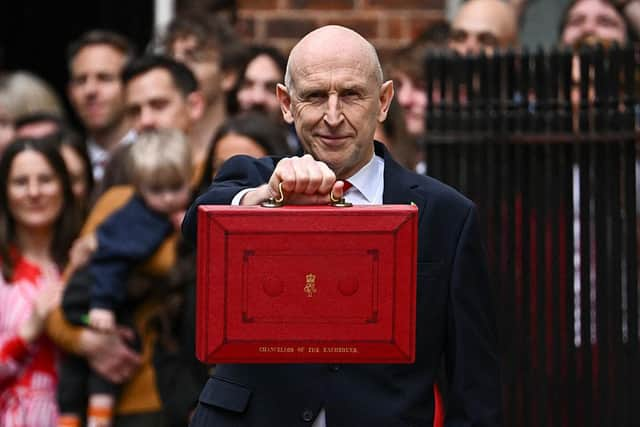
John Healey’s first Budget as Chancellor didn’t impress reader
Another Healey Budget nearly 50 years since the last one. Denis was remembered satirically as a “silly billy” while John’s first budget seems more willy nilly as to whether he wanted it or not.
Perhaps that’s because every budget now is constrained by bond markets worried about the escalating national debt. One thing remained the same, Healey budgets focus on spending with borrowing scheduled to increase in future years on previous estimates. Healey resigned as defence secretary because he felt 3 per cent of GDP needed to be spent on defence by 2030 but despite committing to it he failed as Chancellor to set out how he would get there.
An easy answer would have been to cut welfare but even if Andy Burnham had wanted to it’s clear, like Keir Starmer, his backbenchers would have opposed that. Instead Labour are trying to convince us they will get hundreds of thousands of the million idle young people into work. It was a key part of their manifesto yet halfway through their parliamentary term it hasn’t worked, so why trust them now?

Attention now turns to Burnham’s much-vaunted ten-year plan, which will include further detail on changes to the NHS, creation of a national care system, greater devolution and closer ties with the EU. Changes to welfare will be done “in the Labour way”.
That’s worrying given welfare spending is expected to rise to over £400 billion by 2030, over a quarter of government spending and nearly twice NHS spending. Once again Labour would rather promote the nanny state than self help, but the latter is what is needed, along with securing our own energy security to cut bills.
Neil Anderson, Edinburgh
Ban fireworks
It's coming up on that time of year again: The Great Waste. Waste of money, waste of time, waste of resources and waste of the environment.
Police forces up and down the kingdom prepare for Bonfire Night and the days before and after it. In Glasgow Operation Amberlight will employ around 1,700 officers from Police Scotland and 18 forces from England and Wales to keep the peace before and after 5 November.
Fireworks cause flashbacks to veterans, scare domestic and wild animals witless, pollute the air, leave litter scattered far and wide, and disturb people who just want a quiet night in, in their own homes. In some cities bonfires are used by louts and thugs to attract the fire brigade who are then attacked. They are also acquired by thugs who infiltrate demonstrations and use them against the police. They have no place in modern society. Some supermarket chains are refusing to stock them but some shops still do – shame on them.
What is required is a total ban on selling fireworks, not only to the general public but to any business who wish to use them for weddings, celebrations and so on. They are things that time has passed by. Parents should educate their children accordingly.
William Loneskie, Oxton, Lauder, Berwickshire
Tidal is answer
In his letter of 27 October, Ian Moir is quite right to point out the “Dunkelflaute” (dark doldrums) vulnerability of wind and solar. Mind you; how often do such days occur, especially offshore?
What is almost totally overlooked in the energy debate is Scotland's potential for 100 per cent-reliable tidal, be that from dams or stream. At the British level, a 2021 paper to the Royal Society pointed out the huge potential of tidal power, with a Severn Barrage alone able to supply 6-7 per cent of demand. Dams also have the advantage that road/rail can be slung across them.
George Morton, Rosyth, Fife
Bags of trouble
In the pursuit of unsustainable excellence, it would appear the simple provision of a school bag for all early starters by the SNP pushes them to the fore once more.
There is obviously the cost, £2.7 million, but there are the social issues which need addressed. It would have been pertinent to ask for advice on style, size etc.
I assume they did not even ask their own children, as some issues would have put the boot into this latest vanity project. The first being the colour. Wee Jimmy the Jambo, Helen the Hibee and Cedric the Celtic fan will, without doubt, refuse to use this botched blue bag due to the affiliations they have to their clubs of choice.
Secondly, the make/style. It isn’t Adidas, Puma, Nike or any one of a number of style and brand leaders in that field. No, when it comes to policy, these bastions of democracy can’t even ask for the views of the recipients under their own roofs.
Perhaps a better use of the bags would be to make every SNP MSP wear one to and from “work” and fill it with the wages they don’t earn.
I wonder how long it would take for the zip to burst, carrying all that freeloading dosh...
David Millar, Lauder, Scottish Borders
PR campaign
William Ballantine suggests the Alternative Vote or the Supplementary Vote as replacements for the obviously faulty First-Past-The-Post system we use to elect the UK Parliament (Letters, 26 October). Both would ensure MPs were elected with a majority of the votes in each single-member constituency. But neither could reliably deliver the stability he seeks.
With the Alternative Vote a party whose candidates won 51 per cent of the constituencies could form a single-party majority government with the support of only 26 per cent of the voters.
The Supplementary Vote is a very poor version of the Alternative Vote as only the second preferences marked for one of the top two candidates are counted.
If single-party majority government is the overwhelming requirement, the solution is quite simple. Hold a Proportional Representation election by whatever method you choose and give 55 per cent of the seats to the single party with the most votes.
But in the UK we do not elect a government, we elect a Parliament. As we claim to operate a representative democracy there is an expectation that the elected parliament will be properly representative of those who voted. For that we need a properly implemented PR voting system.
James Gilmour, Edinburgh
Not so rosy
Sara Tendi-Smith paints a rosy picture of Israel as a democratic state (Letters, 28 October). She justifies maintaining that view by arguing that it is crucial when fighting antisemitism.
The International Holocaust Remembrance Alliance describes antisemitism as where “Manifestations include the targeting of the state of Israel conceived as a Jewish collectivity”. But the Israeli government itself defines Israel as a Jewish state – ie a collectivity of Jewish people. Furthermore, the Israeli Supreme Court has reinforced that view by making it unlawful to try to dismantle the concept of Israel as a state with an exclusively Jewish identity.
This includes preventing political parties being allowed to stand for the Knesset if the consequence of their being successfully elected results in Israel being abolished as a Jewish state and replaced with a secular state where all citizens are treated equally and with the same rights irrespective of their religion. That’s a sign of a theocracy rather than a democracy.
What is even more idiosyncratic is that people who convert to Judaism can acquire these rights despite not living within Israel’s recognised boundaries and despite there not being a drop of Semitic blood in their veins. For instance, in 2002 some 90 Peruvian Indians converted to Judaism in Peru and were then flown to Israel and settled illegally in the West Bank, where they acquired full rights as Israeli citizens.
Meanwhile, Palestinian families of Semitic origin who have lived in the same area for hundreds of years are not only denied those same rights, but can be collectively abused, evicted, have their homes demolished and be called "scum” without such actions in themselves being described as antisemitic in nature.
This is the reality.
Robert Menzies, Falkirk
Oh, good work
Well done to SNP MP Lara Bird, Green MSP Kate Nevens and their Progressive International colleagues for standing up for the arab farmers against Jewish settlers and the IDF.
I look forward to reading about their exploits when they go to Sudan, Myanmar, Nigeria, Congo and China to focus the world's attention on the genocide, massacres, rapes and repression in these countries.
And if not, why not?
Allan Sutherland, Stonehaven, Aberdeenshire
Ghost of a chance
I have almost become inured to the poor understanding of science; when the SNP and Greens appear to believe you can generate electricity from solar at night and from wind on calm days, that’s bad enough.
Just think for a second, though, how bad it would be if the numerically deficient Scottish Tories were in power? Craig Paton’s article on Tuesday 26 October regarding the Scottish government’s public sector “ghost workers” tells us the Tories believe they could fund 584 junior doctors with the £21.8 million spent annually on them.
Yes, that would just cover their starting salary of £37,316.
But what about National Insurance and Pension contributions – or do they have a separate branch on the Scottish Money tree for those?
Neil Robertson, Liberton, Edinburgh
Write to The Scotsman
We welcome your thoughts – NO letters submitted elsewhere, please. Write to [email protected] including name, address and phone number – we won't print full details. Keep letters under 300 words, and in the body of the email – no attachments – and avoid 'Letters to the Editor/Readers’ Letters' or similar in your subject line. If referring to an article, include date, page number and heading. No poems.
Comments
Want to join the conversation? Please or to comment on this article.