
No VAT rise, but budget brings quiet shake-up for businesses says Scottish indirect tax expert


There was no increase in the headline rate of VAT in this year’s Budget, but a series of less prominent announcements could still have significant implications for businesses.
Here Paul Russel, Head of VAT and Indirect Tax at the Scottish firm Armstrong Watson, accountants, business and financial advisers, gives his take on the VAT changes ahead.
Several announcements point towards a changing VAT system, with increased responsibility placed on online platforms, more transactions brought within the UK VAT net, and increased HMRC scrutiny. While many of the measures won’t take effect until 2027 or later, businesses should start considering now how the changes could impact their cash flow, systems, pricing and compliance obligations.
Major shift for online marketplace sellers
Perhaps the most significant change affects businesses selling through online marketplaces.
From October 2027, marketplaces will collect VAT on sales made by VAT-registered sellers, as well as UK businesses with £90,000 or more in annual marketplace sales. This potentially has a very broad reach, from takeaways using delivery platforms to retailers selling through Amazon, eBay and Etsy.

For VAT-registered businesses, this is about much more than compliance. Instead of collecting VAT and paying it to HMRC themselves, the marketplace will do so on their behalf. That could have implications for cash flow, VAT accounting and reconciliations, particularly for businesses with significant sales through third-party platforms or a mixture of direct and marketplace sales.
EV charging ‘driveway divide’ remains
The different VAT treatment of electric vehicle charging continues to raise concerns, as public and workplace EV charging remains subject to 20% VAT, while domestic electricity continues to benefit from the temporary 0% rate. This creates what has become known as the ‘driveway divide’.
Those able to charge at home benefit from a substantially lower VAT rate, while those without off-street parking are often reliant on public charging and face higher costs.
For households considering a switch to electric vehicles, this remains an important part of the overall cost calculation.
Social housing change could support development
From April 2027, qualifying land sales to social housing providers will benefit from a new VAT zero rate.
This measure has the potential to remove VAT costs from parts of the development chain, improving the economics of delivering affordable housing. However, much will depend on the detailed rules and which organisations and transactions qualify. Developers and housing providers should review upcoming projects and consider whether timing or structure of developments could be affected.
Private-hire operators face VAT changes
VAT and private hire has been a developing area for several years.
Following the Government’s move to prevent most private-hire journeys from using TOMS from January 2026, the Budget announced a further change which will require larger operators to account for 20% VAT on the full passenger fare from January 2028.
For affected operators, the implications extend beyond the VAT return, and they will need to consider the impact on pricing, margins and driver earnings, as well as whether that additional cost can realistically be passed on to customers.
Greater HMRC scrutiny
Funding announced for 670 additional HMRC compliance officers should, in principle, improve HMRC’s ability to deal with enquiries and compliance work. However, VAT is a highly technical area, and additional headcount will only be effective if it is matched by appropriate technical training and experienced supervision.
For businesses, greater HMRC resource could make robust VAT processes and supporting records increasingly important. Errors that may historically have gone unchallenged could attract greater scrutiny as HMRC expands its compliance activity.
Planning ahead
Taken individually, some of these measures may appear relatively targeted. Collectively, however, they point towards a VAT system in which more responsibility is being placed on intermediaries, more transactions are being brought within the UK VAT net, and HMRC has greater resources for enforcement.
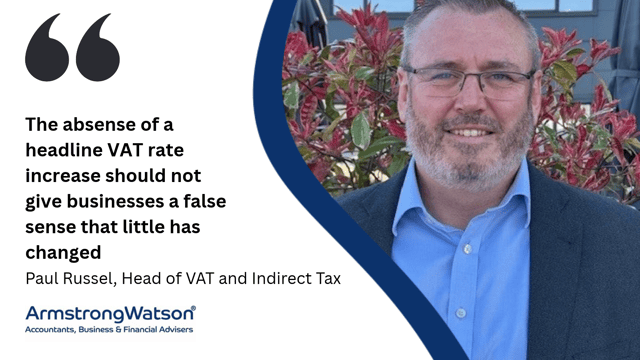
The absence of a headline VAT rate increase should not give businesses a false sense that little has changed; instead, those directly affected by the changes will need to plan ahead to help avoid unwelcome surprises when the new rules come into force.
If you are affected by any of the changes or would like VAT advice and support, please get in touch. Call 0808 144 5575 or email [email protected]. And visit the Armstrong Watson website for more information and to view a full range of their services.